
Published Mar 2026
Subscribe to receive latest resources on supply chain design
Reducing emissions is no longer optional-but neither is maintaining high service levels. The real challenge isn’t choosing between sustainability and performance. It’s designing a supply chain that delivers both.
At Lambda SCS, we’ve seen leading brands achieve double-digit emission reductions-often around 15%-through structured supply chain optimisation, without compromising service metrics. Here’s how.
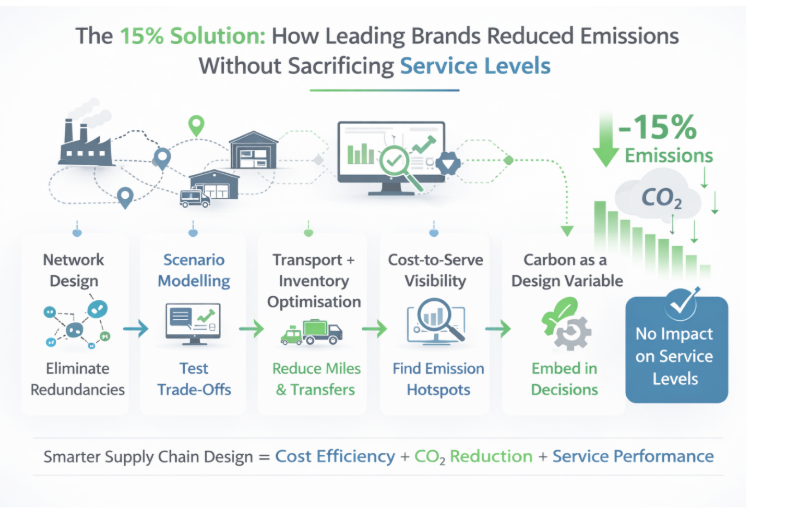
Emission reduction doesn’t begin with isolated transport decisions. It starts with strategic network design.
By modelling warehouse locations, distribution flows, and demand clusters using advanced optimisation tools like OptiFlow, companies identify structural inefficiencies-excessive miles, redundant movements, and suboptimal node placement.
The result?
Fewer unnecessary movements, reduced distance travelled, and lower emissions while protecting delivery timelines.
Leading brands don’t guess. They simulate.
Through structured scenario modelling, organisations evaluate:
This data-driven approach ensures emission reductions are achieved without eroding customer experience.
Transport decisions cannot be separated from inventory strategy.
By aligning:
Companies reduce partial loads, unnecessary transfers, and emergency shipments-all of which drive emissions up.
Integrated optimisation helps maintain on-time delivery performance while reducing overall transport intensity.
Many emission hotspots hide inside inefficient cost-to-serve structures.
With proper analytical modelling, brands uncover:
Once visible, these can be redesigned without affecting service commitments.
The biggest shift we see in leading brands is this:
Carbon is no longer a reporting metric-it’s a design constraint.
By embedding sustainability into network optimisation models, organisations can quantify emission impact alongside cost and service levels.
That’s how the “15% solution” becomes achievable-not through compromise, but through smarter design.
Reducing emissions doesn’t require sacrificing service.
It requires better modelling, stronger analytics, and structured optimisation.
At Lambda SCS, we help businesses redesign supply chains that are cost-efficient, resilient, and measurably lower in carbon intensity-without compromising performance.
If sustainability is on your agenda, the answer isn’t reduction through restriction.
It’s optimisation through intelligence.