
BLOG
Carbon-Efficient Supply Chain Design: Aligning Cost and CO₂ Performance
Published Feb 2026
Table of Contents
Subscribe to receive latest resources on supply chain design
Why Carbon Reduction Is Now a Supply Chain Design Problem
Most organizations attempt to reduce carbon through reporting frameworks, compliance initiatives, or offset programs. Yet emissions are not primarily a reporting problem-they are a design problem.
Carbon emissions in supply chains are the direct outcome of structural decisions: where facilities are located, how products flow through the network, how frequently inventory moves, and which transportation paths are used.
For many organizations, carbon initiatives stall because they are evaluated separately from cost and service performance. When sustainability is treated as a parallel workstream, it remains disconnected from the decisions that actually shape emissions.
The reality is simple:
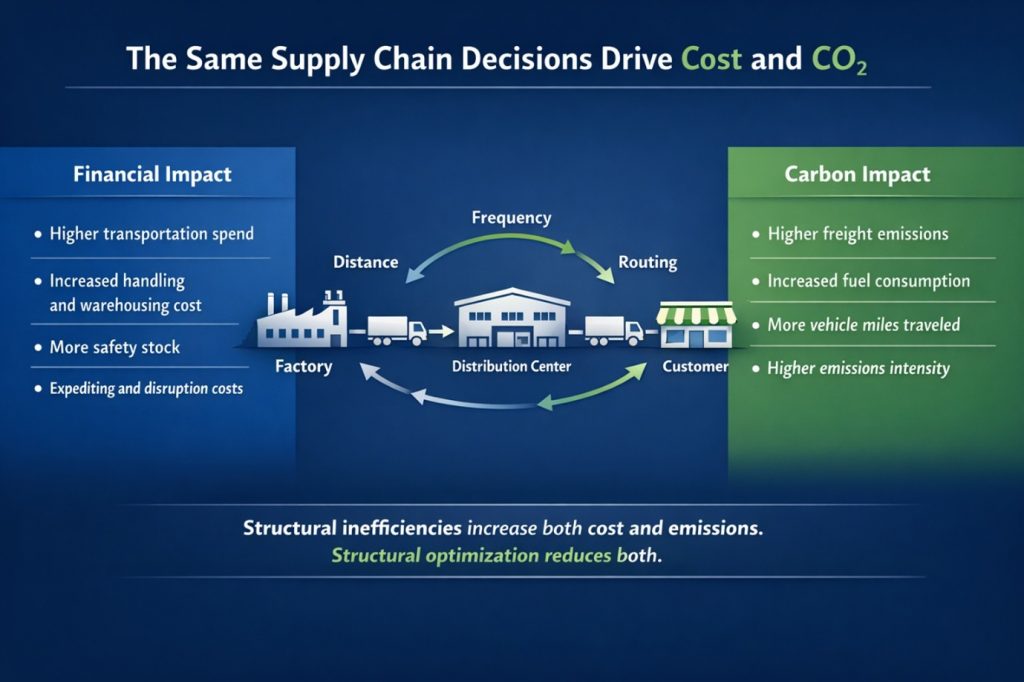
The same decisions that determine supply chain cost efficiency also determine CO₂ output.
At Lambda Supply Chain Solutions, we believe sustainability must be embedded directly into supply chain design-so carbon reduction becomes a natural outcome of better operational decisions, not a trade-off.
Where CO₂ Is Created in the Supply Chain Network
From a network perspective, CO₂ emissions are largely driven by a small set of structural and operational factors:
- Distance travelled across the network
- Number of handoffs between facilities
- Frequency of replenishment and inter-facility transfers
- Inventory placement relative to demand
- Transportation routing and asset utilization
When networks are fragmented or poorly designed, products travel farther, move more often, and rely on inefficient routing-driving up both cost and emissions.
Modern digital twin–based network design tools such as OptiFlow make these structural drivers visible, allowing organizations to identify where avoidable distance, redundant movements, and inefficient handoffs are embedded in the network.
Designing Networks That Optimize Cost and CO₂ Together
Modern supply chain network design enables organizations to optimize cost and carbon simultaneously rather than treating them as competing objectives.
Facility Location & Network Structure
Optimizing the number, location, and role of distribution centers can:
- Shorten average delivery distance
- Reduce inter-facility transfers
- Lower transportation cost
- Cut emissions tied to long-haul movements
These structural decisions have a compounding impact on both financial and environmental performance.
Product Flow & Inventory Strategy
How products move through the network matters just as much as where facilities are located. Poor inventory placement increases replenishment frequency, emergency shipments, and unnecessary transportation.
Optimized product flows and inventory allocation:
- Reduce unnecessary touches and back-and-forth movement
- Improve consolidation and asset utilization
- Position inventory closer to demand
- Improve service reliability while lowering emissions
For example, redesigning product flows to eliminate avoidable inter-DC transfers can simultaneously reduce freight spend and remove thousands of miles of unnecessary transportation-cutting both logistics cost and CO₂ intensity.
Integrated network modelling platforms like OptiFlow allow organizations to evaluate facility structure, product flows, and inventory placement within a single decision framework-ensuring that cost efficiency and carbon reduction are assessed together rather than sequentially.
From Reporting Carbon to Designing with Carbon in Mind
Many organizations focus on measuring and disclosing carbon performance after operational decisions are made. While reporting is essential, it does not change the structural drivers of emissions.
Real progress occurs when sustainability is embedded in how supply chains are designed-not how they are reported.
Organizations that integrate carbon directly into network design decisions typically achieve:
- Reduced transportation distance and structural freight intensity
- Lower reliance on emergency shipments
- Improved asset utilization
- Measurable, sustained CO₂ reductions
- Stronger alignment between ESG targets and financial performance
The shift is subtle but powerful:
Reporting carbon measures past performance.
Integrating carbon into supply chain design shapes future performance.
When carbon becomes part of structural decision-making, sustainability evolves from an obligation into a competitive advantage.
Conclusion
Carbon-efficient supply chains are not built by choosing sustainability over efficiency.
They are built by designing supply chains intelligently.
Sustainability is not a trade-off- it is a design outcome.
When cost, service, and CO₂ are evaluated together through network design, the supply chains that win on cost are often the same ones that win on carbon- because they were designed intentionally.