
Published April 2026
Subscribe to receive latest resources on supply chain design
E-commerce logistics is becoming increasingly complex as customer expectations for faster delivery continue to grow. At the same time, rising parcel shipping costs and increasingly complex carrier pricing structures are putting pressure on supply chain teams.
The challenge is no longer just moving parcels faster-it’s doing so at a cost structure that remains sustainable at scale.
To maintain service levels while controlling transportation costs, companies are turning to smarter logistics strategies such as network optimization and zone skipping. At Lambda SCS, these strategies are powered by advanced analytics and supply chain design technology like OptiFlow, enabling businesses to optimize parcel networks, reduce shipping costs, and improve delivery performance.
Today’s logistics networks operate in a highly dynamic environment. Rising fuel prices, evolving carrier pricing structures, and increasing parcel volumes already make transportation planning challenging.
External disruptions-such as fuel volatility and shifting carrier networks are making parcel logistics more unpredictable and expensive.
For high-volume e-commerce shippers, minimizing unnecessary transportation movements and optimizing parcel routing strategies is becoming critical. This requires moving beyond isolated tactics and adopting a network-wide perspective-where decisions are evaluated across cost, service, and operational efficiency.
Before applying tactics like zone skipping, leading organizations focus on optimizing their overall parcel network design.
Network optimization involves evaluating:
By redesigning these structural elements, companies can eliminate unnecessary movements, reduce average shipping distance, and improve delivery speed.
This network-first approach ensures that parcel strategies are not applied in isolation, but as part of a coordinated logistics design. Once the network is optimized, techniques like zone skipping can be applied to further reduce cost while maintaining service level.
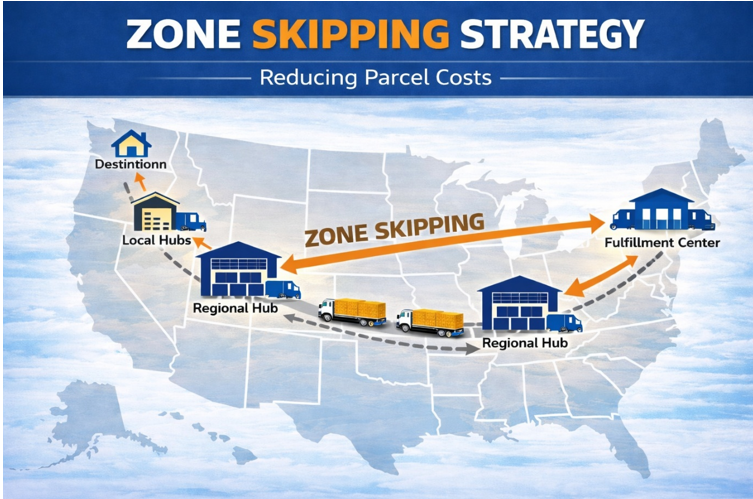
Parcel carriers divide delivery areas into geographic shipping zones, and shipping costs increase as parcels move across more zones.
Zone skipping reduces this cost by consolidating parcels and transporting them in bulk to a destination region before entering the local delivery network.
Instead of sending individual parcels through multiple carrier hubs, shipments are moved directly to a regional location where they are injected into the last-mile delivery network. By bypassing intermediate zones, companies can reduce shipping costs while maintain service levels.
In simple terms, zone skipping reduces both distance travelled and cost per parcel.
While strategies like zone skipping are effective, identifying the best opportunities requires strong analytics and network modelling-especially when dealing with complex carrier pricing structures and high-volume parcel flows.
Using OptiFlow, companies can:
The platform can ingest real parcel data and simulate e-commerce logistics flows, allowing companies to make accurate, data-driven, and executable decisions.
When companies apply a network optimization approach supported by tools like OptiFlow, they achieve measurable operational improvements:
Reducing parcel costs does not require compromising service levels.
It requires better network design, stronger analytics, and structured optimization.
At Lambda SCS, we help businesses design parcel networks that are cost-efficient, resilient, and scalable-without sacrificing delivery performance.
If logistics optimization is on your agenda, it starts with smarter network design-powered by data-driven decision intelligence.