
Published Feb 2026
Subscribe to receive latest resources on supply chain design
The year 2025 delivered a clear lesson for global businesses: tariffs and geopolitical risk are not temporary disruptions. Entering 2026, multiple geopolitical flashpoints are simultaneously reshaping global supply chains in real time. These forces are no longer theoretical risks -they are active constraints influencing sourcing, manufacturing, and distribution decisions today.
Organizations that have already begun adapting are building resilience into their networks. Those that have not face growing exposure as uncertainty becomes structural rather than episodic.
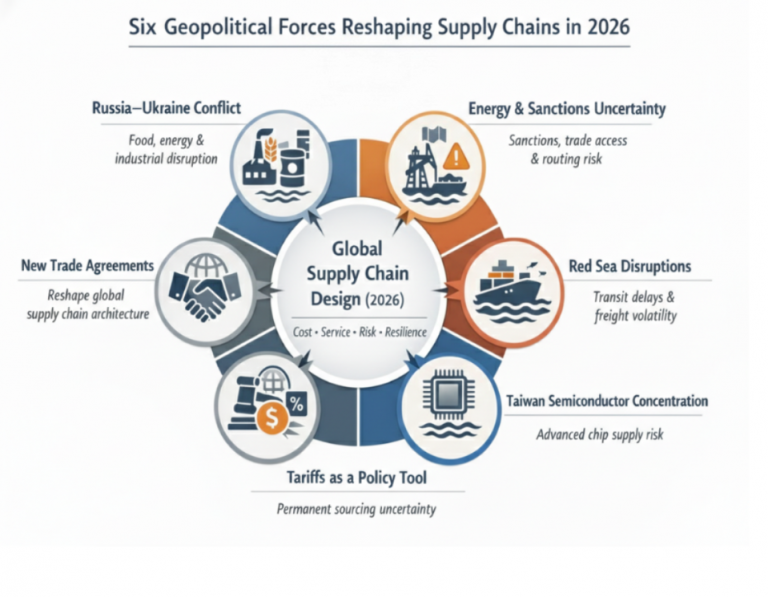
Tariffs have effectively become a standing feature of US trade policy. Current tariff levels include 20–32% on China, 18% on India, and 25% on countries conducting business with Iran, alongside renewed tariff threats tied to broader geopolitical objectives.
Although some high-profile tariff proposals -such as those linked to Greenland – were later withdrawn, they stalled progress on transatlantic trade negotiations and demonstrated how quickly trade policy can be leveraged as a strategic tool. Similar signals toward Canada, tied to its trade engagement with China, add further uncertainty for integrated North American supply chains.
Impact:
Companies are being forced to permanently redesign sourcing footprints, accelerate nearshoring and friend-shoring strategies, and embed tariff and sanctions scenarios into core supply chain and financial planning.
Geopolitical developments in Venezuela and Iran are introducing another layer of uncertainty into global energy and trade flows. In early 2026, US intervention in Venezuela’s oil sector led to a restart of production, though analysts estimate it will take two to three years before output reaches levels that materially affect global supply.
At the same time, the US has imposed a 25% tariff on countries conducting business with Iran, increasing compliance risk across global trade lanes. As a result, some Asian and European suppliers are rerouting shipments through alternative regions, adding two to four weeks to lead times.
Impact:
Shipping routes are becoming longer and less predictable, logistics costs are rising, and energy-dependent manufacturers face sustained margin pressure driven by uncertainty rather than immediate supply shortages.
Since November 2023, Houthi militia have carried out more than 190 attacks on commercial shipping, sinking four vessels by mid-2025. In response, shipping lines have rerouted roughly two million containers around the Cape of Good Hope, raising costs (freight and insurance) and adding roughly 10–14 days to Asia–Europe transit times.
Impact:
Freight rates remain volatile, lead times have lengthened, and the return to Suez remains conditional on sustained regional stability- leaving global supply chains exposed to sudden disruption.
Taiwan produces approximately 85% of the world’s advanced AI semiconductors, accounting for nearly 60% of global chip supply overall. Ongoing geopolitical tension across the Taiwan Strait represents one of the most concentrated supply risks in the global economy.
Any escalation would immediately disrupt semiconductor availability across industries including AI, automotive, consumer electronics, and industrial manufacturing, with limited short-term alternatives at scale.
Impact:
Extended lead times, constrained capacity, and persistent uncertainty for technology-dependent industries.
Now in its fourth year, with no clear resolution in sight, the Russia–Ukraine war continues to disrupt global food and energy supply chains. Ukraine supplies approximately 25% of global wheat and barley, yet Black Sea port access remains constrained. An estimated 15% of Ukraine’s grain storage capacity has been destroyed, and roughly 8 million tonnes of grain have been appropriated from occupied territories. Click Here
The conflict has also affected the availability of key industrial inputs and energy-linked materials supplied by both Russia and Ukraine. Sanctions, trade restrictions, and infrastructure disruption have altered sourcing patterns across Europe and beyond, increasing cost volatility and supply risk for downstream manufacturers.
Impact:
Grain markets remain volatile, developing economies face heightened food insecurity, and manufacturers continue to experience elevated costs and supply uncertainty across energy- and materials-intensive industries.
Recent trade agreements and negotiations, such as the EU-India trade discussions, renewed India-Canada engagement, and ongoing conversations around closer India-US economic cooperation are signalling a broader shift in how global supply chains are being structured. Together, these developments are strengthening alternative trade corridors and reducing reliance on a single dominant sourcing region.Click Here
The newly announced U.S-India trade deal further accelerates the global shift toward India as a scalable sourcing hub, while also showing that trade access is increasingly tied to geopolitical alignment-not just cost and capability.
As these agreements improve market access and regulatory alignment across multiple regions, companies are using them to diversify sourcing, manufacturing, and distribution footprints. The result is a gradual move toward multi-hub supply chains, where production and suppliers are spread across regions connected by newer trade partnerships, improving resilience and reducing concentration risk in an increasingly fragmented global environment.
Organizations are responding with structural changes to how supply chains are designed and managed:
Increasingly, leading organizations are running regular scenario exercises: What if Suez closes? What if Taiwan faces a blockade? What if tariffs increase to 50%? These scenarios are now central to executive decision-making.
2026 marks a turning point. Supply chains can no longer be optimized solely for cost in a world defined by geopolitical fragmentation and structural disruption.
Organizations that redesign their networks now-with resilience, flexibility, and scenario-driven planning at the core -will be better positioned to absorb future shocks. Those still planning for cost face increasing exposure as uncertainty becomes the norm.
The cost of adaptation is manageable. The cost of inaction is far higher.